




The two hardest studies to design are now the fastest to start. Describe the trade-off you're trying to understand—Research Agent builds the conjoint or MaxDiff around it.
Conjoint and MaxDiff produce some of the most decision-grade answers in research: what to build, what to charge, what to prioritize. They're also the two methods most teams avoid, because designing them well has always meant a specialist and a slow setup. Research Agent moves the entry point. Describe the business question in plain language, and the Agent drafts a methodologically sound study you can review, refine, and field—in minutes, not days.
If you've ever shelved a pricing question because a conjoint felt like too heavy a lift, or reached for a rating grid when a MaxDiff would have given you a real ranking, these are for you.
1. Conjoint: Model the Trade-offs Behind What People Actually Choose
Conjoint answers the questions a rating scale can't: how customers weigh features against price, which package wins, what they'll give up to get the thing they want most. The barrier has always been the build—attributes, levels, the design plan, and the analysis underneath it.
Now you describe the decision—"I need to understand how buyers trade off price, battery life, and warranty on our next model"—and Research Agent proposes a conjoint built to answer it. Attributes and levels drafted, design logic handled, methodology applied by default.
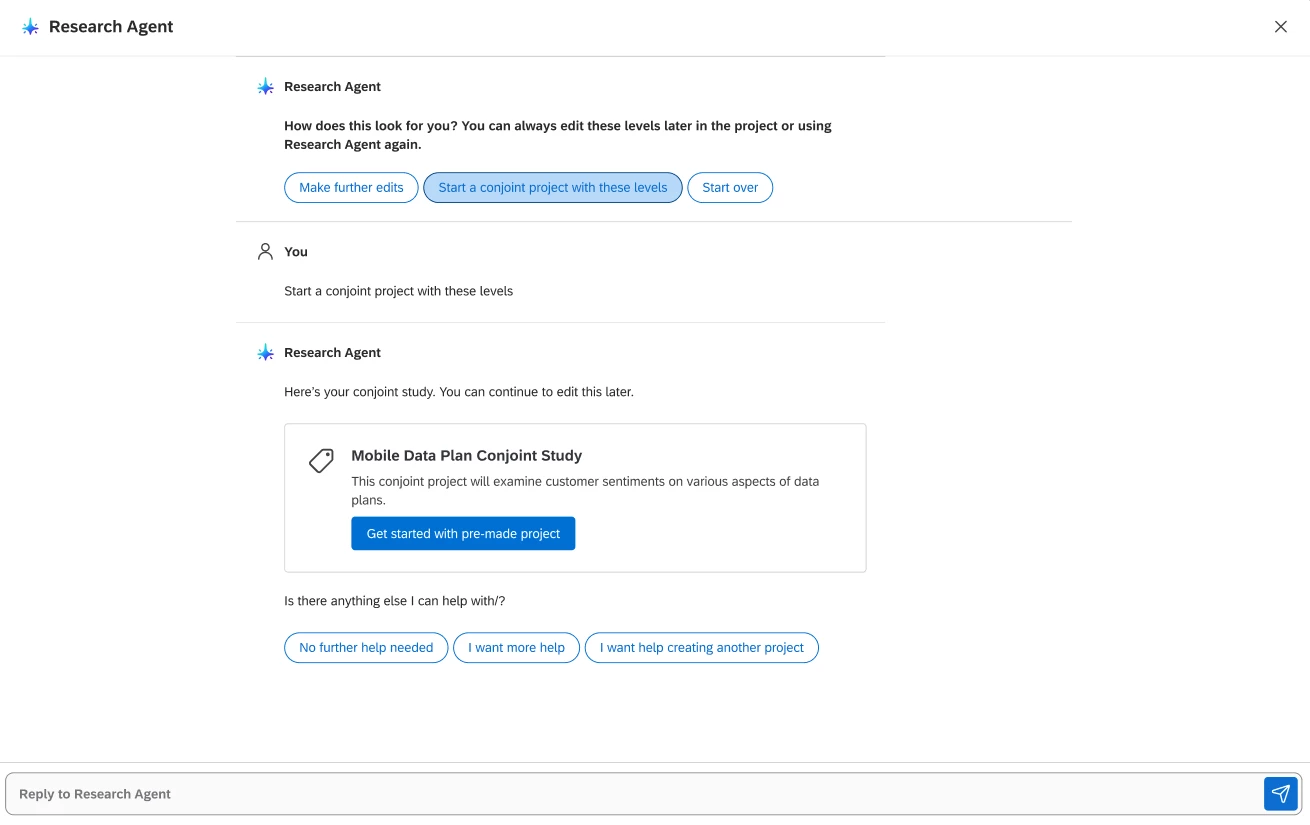
Three things make this more than a faster setup:
Built the way a research expert would build it. The Agent designs against Qualtrics research science—its judgment grounded in decades of Qualtrics research methodology and real-world studies—so a first-time author gets a design a methodologist would recognize, not a general model's best guess at method.
A glass box, not a black box. You review and edit the design before it fields. The Agent drafts; you approve. Nothing runs that you haven't seen.
New help with the build—no change to the math. The agentic assistance is additive: it changes how you create the study, not how the results are computed. Once you field, analysis runs on the same proven Qualtrics engine that has always powered conjoint—utilities and shares calculated exactly as before. You're gaining a faster, expert-guided way to build the study, and losing nothing in the rigor you already trust.
2. MaxDiff: Rank What Matters When Everything Looks Important
When you have a long list—features, messages, benefits, claims—and need a priority order you can defend, MaxDiff beats a rating scale because it forces real trade-offs instead of letting everything score an 8. The friction is in the construction: balanced item sets, sound design, enough tasks to model cleanly without exhausting respondents.
Describe what you're prioritizing—"Help me rank these 15 potential features by what would most influence purchase"—and Research Agent drafts the MaxDiff. Item sets balanced, design handled, ready for you to review and field.
Prioritization the whole team can run. The advanced method becomes a conversation, so a PM or a strategist can stand up a defensible ranking without waiting on a specialist.
A real ranking, not a flattened one. The output tells you what to focus on and what to set aside—the trade-off signal a scale grid loses when everything clusters at the top.
Same rigor, same control. The methodology is built in and the design is yours to edit before it runs, exactly as with conjoint.
Where Teams Are Using This Today
Pricing and packaging — Conjoint to find the package and price point that wins, before committing engineering or GTM spend.
Roadmap prioritization — MaxDiff to settle "what do we build next" with a ranked, defensible answer instead of the loudest voice in the room.
Message and claims testing — MaxDiff to rank which value propositions actually move buyers, not which ones the team likes.
Feature trade-off analysis — Conjoint to quantify what customers will give up, and what they won't.
First-time quant — Teams running their first conjoint or MaxDiff with no methodologist on staff, getting to a sound design on their own.
The bigger unlock: conjoint and MaxDiff have always produced the most decision-grade answers and demanded the most expertise to run. Lowering the setup barrier without lowering the methodological bar means the highest-stakes trade-off calls—pricing, portfolio, roadmap—no longer wait on specialist bandwidth.
Why This Matters
This closes a specific gap: the distance between a high-stakes trade-off decision and the rigorous study that should inform it. Conjoint and MaxDiff give you answers you can stand behind—but only when they're designed correctly, which is exactly what used to keep them out of reach for most of the team. Research Agent moves the expertise into the system, so the method fits the decision instead of the decision bending to whatever was easy to field. You keep the control, the audit trail, and the rigor. You lose the setup tax.
We'd Love Your Input
A few questions for this community:
- Which trade-off decisions would you run more often if setup weren't the barrier?
- For your team, what's the bigger unlock—conjoint for pricing and packaging, or MaxDiff for prioritization?
- Where do you most want the Agent to keep a human in the loop before a study fields?
Your feedback directly shapes what we build next.
Want to Learn More?
Reach out to your account team or explore the support documentation: